

Leaderboard
-
Jdude95
Members17Points1,376Posts -
themagician
Members5Points8,300Posts -
-nick.white.1543
Members4Points176Posts -
DaptoFunlandGuy
Members4Points15,646Posts



Popular Content
Showing content with the highest reputation on 28/06/18 in Posts
-
https://paradisecountry.com.au/animals-and-shows/shaun-the-sheep
 4 points
-
After the pump had 3-5 issues within the week leading up to the incident, an external electrician was being brought in the day after the incident to inspect the pump. Mr De Villiers was the electrical maintenance engineer who advised the park technicians how to restart the pump on the day of the incident as the electricians were busy in White Water world at the time. The park technicians then had the knowledge to reset the pump by them self. Mr De Villiers has been an electrician since 1992 Mr De Villiers ended his time on the stand by offering his sincerest condolences to the families of the victims. Quentin Dennis Electrical maintenance Been employed since Oct 2008. Outlined his general duties in his role which are the same as the previous electrical maintenance staff. Outlined his knowledge of the park policy and the breakdown procedure which is the same as previous maintenance staff. If a fault occurred on TRR, due to the complex nature of the ride, a supervisor must attend. If there was a fault on TRR an alarm would go off through the park radios alerting maintenance staff and the supervisory team to send all available staff to TRR. Mr Dennis has brought it to the attention of supervisors before about the unsafe and dangerous nature of the wiring in the main control panel. Mr Dennis states that it was brought up often and that the wiring should be labelled. And with that we are adjourned for the day. I shall post the compiled notes later and pick this up tomorrow.3 points
-
When the turntable was operating, the rafts were not stopped. See the disney grizzly rapids video I posted above for an idea of how they did they. Once the turntable was switched off, there would have been a steel panel, hinged on the floor, with a hydraulic or pneumatic ram attached to it that would move sideways - towards and away from the loading platform. When the raft was in the correct position, the operator would engage the ram, which would sandwich the raft between the station and the ram, keeping it wedged whilst guests were loaded \ unloaded. Although this kept the raft in position, as a single pivot point, loading on an angle (if the gap didn't line up properly) would cause the rafts to wobble a little - which is why (i think) the rails were installed under the water in the station, to prevent the rafts from tilting much under the shifting weight. I think both Australian rapids rides had similar issue with the turntable - in a risk averse world, there was too great a risk of someone falling into the water with a moving platform and a moving raft. By stopping both, it was deemed 'safer' - but because stopping rafts increased chances of collision, other control measures were needed to maintain safety. By all accounts it sounds like Wonderland did, and Dreamworld didn't manage those control measures effectively. I can't speak for dreamworld, but in the rotating turntable days at wonderland, usually - guests would simply be sent on another round, and the turntable would only be stopped in a serious emergency. In other words if a guest was taking too long to get in \ out, the ride would not be stopped, and they'd be instructed to stay on \ stay off and wait for the next one. The turntable could be stopped, but that would muck up the spacing for the entire ride, so would only ever be done for an emergency.3 points
-
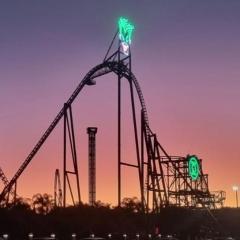
Here is a look at all of the theming and decorations throughout the park, definitely Joker focused this year


 3 points
-
Mr Wilson has attended TRR due to a pump fault previously and states that it’s a semi regular occurrence. Mr Wilson was shown photos of the control room/switchboard and states that the safety PLC systems were updated in May 2016. Photos from the switchboard show that all the labels are hand written on. Mr Wilson would take a photo of the fault error code on the pump controls for future reference/discussion. Mr Wilson is being shown photos of the switchboard and explaining the functions. I won’t go into details with this as there was no new or interesting information from that walkthrough. Reference pictures would also need to be seen to understand the explanations given by Mr Wilson.3 points
-
The picture wasn't at a high angle so it was hard to tell. The photos were taken from the station area. I'm not sure what caused the first raft to become stuck as it wasn't mentioned when they were discussing it. The general vibe I've been getting from the courtroom is that they are more pointing fingers at people and aren't looking as much into the mechanical and modification side of it. I'm really hoping the focus shifts more towards the mechanical side of things before the inquest is over.3 points
-
2 pointsI'm hoping it would be similar to that Chinese zoo that dresses its empoyees up as animals to practice for an escape scenario.2 points
-
Francoire De Villiers Electrical maintenance Has been employed for 4 years Has worked with the fitter/turners when he started so he could learn the mechanical side of the ride. Mr De Villiers has advised that he wasn’t required to and never tested the e-stop button at the unload station. At around midday on the date of the incident, Mr Villiers was aware of 3 previous times the south pump has tripped in the previous week. The CCTV footage was shown to the court but the court was closed while this took place. I saw the first frame of the paused CCTV footage before it was turned off. That may be the closest we’ll get to any actual vision of the accident. On the control booth wall, there is a hose with a valve on the end which is used to inflate and check the inflation levels of the raft which should be done daily. Upon inspection of the inside of the control panel, the wiring was described as a “rats nest” of tangled, loose wires and wires not being connected to anything. It was described that due to this, the panel could have launched rafts and caused faults on its own without operator input. Mr De Villiers states that there was supposed to be upgraded to the ride prior to the incident that would update the control panel. Photos of the panel were shown and it was a cluster of messy wires.2 points
-
2 points
-
Alright I’m back at the inquest day, liveposting has commenced Jacob Wilson Been working at the park since 2012 Electrical maintenance Performed the park technician role often. Mr Wilson states that the park technicians were stretched thin on a regular basis. Mr Wilson was encouraged to raise any safety concerns with his supervisor. The supervisor would then determine the importance of that concern and address it accordingly. Mr Wilson wasn’t asked to read the breakdown policy often, he read out out of his own curiosity. Mr Wilson has been involved with evacuation scenarios on Buzzsaw and tiger escape scenarios and these took place in 2015 and 2016 prior to the incident but states that these scenarios are practiced within the maintenance department. Mr Wilson also completed first aid/CRP training. New lockout procedures were put in place for every ride prior to the 2016 incident. Mr Wilson was not the park technician on the day of the incident but heard the “code 6” breakdown call and decided to head over there anyway. He states he called extra maintenance staff to assist with the “code 6” as TRR would generally require more staff if the guests had to be evacuated. Previous issues that Mr Wilson has attended the TRR for include the conveyor not moving, water in a sensor, a problem with a jack or a ride op has shut the ride down. The supervisor sent 3 additional maintenance team members with Mr Wilson to attend the TRR breakdown.2 points
-
2 pointsI wasn't aware this forum had that function either, normally use the mobile version which doesn't have that text. Turns out on mobile it's a newspaper image to the left of the magnifying glass.2 points
-
Cant find someone culpable and sue them directly without proving negligence. Turning up to work and doing something wrong by accident or in the heat of the moment isnt negligence and you cant be personally liable. Thats what companies have insurance policies for. That someone is going to do a bad job one day and they are going to be sued for it. Worst is your employer can be sued for the incident, and the staff will probably lose their job and insurance companies pickup the tab. So heaping all the blame on an operator is not going to change things for dreamworld come the civil suits. All it does is make them look like bastards for hanging their employees out to dry. It only highlights that maybe those employees shouldnt have been running the ride. Through lack of training, lack of experience or lack of confidence; ultimately it doesnt matter as they put those people in that situation and it is their responsibility to not only provide a safe environment for guests, but employees too. So staffing someone with current training but little to no experience or demonstrated confidence in operating the ride does not mean the employee is competent. All the training in the world is a moot point it the staff are not confident enough to put it into practice or unable to demonstrate competency based on their work. Training someone that morning and turning them over to the ride the same day does not prove competency. Its something that will probably be raised in the findings when the inquest finishes. That training standards and methods were lacking and the inexperience and lack of confidence shown by the ride operators contributed to the deaths.2 points
-
To provide some context to anyone unsure about what @RabbiJody is referring to about these railings. I posted this photo in May 2016 when these railings were installed during the rides maintenance period.
 2 points
-
1 point
-
I like it. I assume the "Joker" in the photos is a staff actor?1 point
-
Yes, I saw that photo. I have seen anything that has been shown to the court. It looked exactly how the rafts looked in 2016 with one raft flipped and resting against the other. One of the seatbacks has been slightly torn apart but i'm not sure if that was caused by the conveyor belt or not. In regards to the rails. The photos magician posted are indeed the rails and they run all the way around through the station including that metal platform that the first raft is resting on in the 2016 incident.1 point
-
Okay everyone, I know I wasn't able to make it today but I have compiled all the notes I took from yesterday and cleaned them up. As I mentioned, Ms Crisp completed a 3 hour walkthrough of the ride with QPS and WHS. 2 hours of this video was shown and i've added into the document some interesting things that I noticed while watching the walkthrough. https://docs.google.com/document/d/1Ayw6_NjtaBHoLiTlSBDNzXoQtiVORt8NTzrVIbsZFzI/edit?usp=sharing1 point
-
1 point@themeparkaddict that's easy. This was taken at our Friday poker night.
 1 point
-
Wow. So much effort for such little achievement. How sad.1 point
-
1 point
-
people speak of this turntable . It never had one? If so where exactly . That old conveyor belt. Should have at least been a manually operated positive action not a negative one in emergency instead of always on. Its crazy to think people are so young and put in the supervisor or training roles . But given what the pay packet is for these jobs people with a bit more experience in life are most likely less interested .0 points






This leaderboard is set to Brisbane/GMT+10:00