

Levithian
Members
-
Joined
-
Last visited
Everything posted by Levithian
-
-
-
The problem is finding something developed with cues for the effects. If the animation is not developed with these in place, you have to sit there for hours/days/weeks, time stamping a text file and developing and testing a cue sheet to program the PLC that runs everything with new sequences to sync with the video. It's not an easy swap out process to build a new show from scratch.
-
It's pretty well land locked, so there isn't a lot of point in replacing useable track vs conversions to something else. It's not really a super rare launch system. It just uses hydraulic pumps and nitrogen filled accumulators to drive a series of hydraulic motors that spin the drum winch the cables attach too. The problem is when it's not an off the shelf part readily available, so even the manufactures have had to produce overhaul/replacement kits for reconditioning/repairing components right from when the ride was developed. Nobody but the manufacturers supply critical components for ANY of the rides. Even if the component was available locally from another supplier, it's just not how it's done and all responsibility for maintaining compliance/quality rests with the ride manufacturer. The biggest problems in recent years have been problems with the diaphragms sealing internally within the accumulators and keeping the pressure balanced, plus prior to that the chiller system that used hydraulic fluid cycles back through to cool down. Those things were really old and needed replacement years ago. Back when they actually gave a damn about launch cycles, on really hot summers days it was possible to cycle the cars too fast that they couldn't keep the hydraulic oil operating temps under control and the ride used to go into alarm because of it. The only thing that would feel similar to a hydraulic launch would be air. It has the same almost instant acceleration you don't get with electro magnets.
-
The old buildings behind HSD were actually carpenters sheds originally. Nothing to do with the services for the fireball or anything air related were out there. LPG storage vessel is against the fence further forward towards the gate, while the buildings remaining towards the grass hill behind/beside the new building they put up, cannot be removed easily. There is an energex feeder/substation (one of three in the park) there, while next door is a room full of services cabinets for stepping down and distributing power from the feeder. You don't actually own the substation and it's not something you just pickup and move with how integrated transmission lines are running to other services underground. Those two small buildings stayed right where they were. HSD guys used the carport for tyre related stuff for awhile, the one the superman float end up parked in permanently, but by large part, they have had a workshop tied to the back of house area for ages. It's directly behind the left corner of the set where the "parking garage" is. The reason why you used to see a HSD car frequently parked out the back was because the park took one of the black evo's and used it as a lead vehicle (police car) for the parades for a long time. They originally had a deal with Mitsubishi Australia, the cars were never plated with compliance plates, just build tags, they were never to be registered. They sold a bunch of the back lot cars off about... I want to say 7ish years ago. 3 of the evo's went as a package, but they also sold a few others like the remaining caprice from the police academy stunt show.
-
It was an example of projection mapping done properly though. The river scene projected on the sand was magic.
-
The jump car was never recertified, that put an end to that ever being put back in use with a new show. It was still there, mitsubishi lancer body and all up until a few years ago. The fireball was fine for a very, very long time into the new show. Neglect and the fact that it was a major project to remove and replace pneumatic components hidden inside the wall and overhaul the control system that triggered it is what put an end to it. Risk aversive fun police put the brakes on anything remotely dangerous (even in a controlled setting). I don't remember the jump car crashing through walls though? I remember the "launch" side was a fake poster looking curtain that hid the launch ram and the "landing" side was a doorway, made it look like it was the opening to an alfresco. It was a frame with half a fibreglass shell that was bolted to a carriage a lot like a coaster car. There was a curved section of track it ran along below the wall. Not sure they would have wanted anything nearby that could fall onto the track/into the wheels. I'm probably wrong, but was there something in the lower door opening at one stage? between the barn doors that swung open and the same drop style curtain currently in use where the polaris jumps through?
-
It's 100% how village like it. They basically set the price for how much they are willing to spend and showtime went away to develop a show for it. They were absolutely bleeding money with the first incarnation of HSD. The vehicles alone cost eye watering amounts to modify/maintain/keep running for the show, so when someone came along and struck a deal to take all that off their hands, they saw it as a blessing. It's just another example of their priorities changing during the late early teens. Within reason, when previously continuing to run police academy even after the guest numbers dropped off, then with HSD which replaced it, the main emphasis was on the show quality with running costs being more a secondary consideration. IE, they didn't want to see the guest experience suffer because they didn't provide enough $$$$$ to put on a decent show. Now? I don't think you could say that guest experience is the leading consideration in anything village do.
-
-
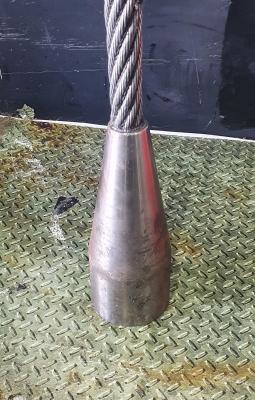
Wire ropes get replaced on superman as preventative maintenance. Same as on batwing. You can't see the internal structure as it's actually made up of multiple spiral strands of wire wrapping inner cores, themselves spiral wrapped forming an even larger inner core surrounded by outer spiral winds. Think of it more like multiple wire ropes surrounding multiple inner ropes spiral wrapped around to form the outer. Most of the reasonable cost testing machines run the length of the rope checking for variations in thickness with very fine tolerances or use very powerful magnets checking for deviations which indicate some sort of deformity (usually broken strands). The absolutely unreasonable machines basically xray the rope. Alternatively, as preventative maintenance you can inspect it and replace it well before the next test date is required or the service life is reached. These are the end stops holding the rope packed tightly. They are sandwiched between wear blocks and bolted into position to anchor them to things like the catch car.
-
-
They are running a hundred laps (or more) a day in testing before anyone even sets foot inside a car. It's pretty much the most intensive run time a ride ever experiences because you don't have the cycling down time experienced by guests getting off/on. You are punishing the ride with the shortest dispatches for hours on end, for days on end, it's like a giant torture test. THEN you switch to live testing with guests in it. The problems usually happen when the test period is cut short because you're either behind schedule trying to make up time or operations put pressure on you to get it open as soon as possible. It's not an issue of safety so it's ok to physically open, but nothing looks worse for maintenance teams when a ride breaks down, sometimes hours after it was reopened. Sadly, often people making decisions much higher up don't seem to place must stock in the public image your park projects to members of the public. So rather than drill it until you're sure the major kinks and bugs are worked out, it's often experiencing situations that make everyone look like amateurs and leave members of the public questioning if it's actually safe and do their maintenance teams know what they are doing.
-
And I simply stated the facts as to why it took so long and happened like it did. At no point did I say you can't split the train or it was impossible. I said there was no procedure in place to do it, they had nothing to attach the car segments to and even when it was considered it was decided it was more disruptive to do so. Pro tip. Nothing. And I mean NOTHING is attempted unless there is a procedure to follow. You know who dictated the whole process? Mack. Know who had no procedure in place for removing a train? Good guess. One big problem with your whole scenario. The train isn't secured suspended from lifting equipment. It has to be clamped and anchored. It's also incredibly difficult to remove a pin or axle from a loaded component. You've got the whole train suspended perfectly in the air, you are overestimating the level of control you have. A regular evac from GL (and every other coaster really) sees track clamps fitted around multiple axles to prevent the train from moving, then its also tied off with a puller/come along as a secondary measure. Bit different doing what you have to do to get people in danger off a train vs putting employees in harm's way trying to split the train. Quite simply, it was deemed risky. You can't sit the train on any of the running gear, place it back in the maintenance bay and return it to service. You have to completely remove the wheel carrier to remove it from the track, so that just leaves the spindles sticking out to bottom. Everything you remove, all the stuff you are suggesting to just sit it on now has to be rebuilt and reassembled. You can unbolt the wheel assemblies relatively easy and pull the axle pins out, but the spindles are not coming out in the field. They take a considerable amount of force to drive the king pin out. I'm not even sure if they would be ok reusing the main spindles if you were to sit the train on top of them as it's not something that is ever done, so best case expect weeks of rebuild time, maybe more if they don't have replacement bearings and fasteners in stock to reassemble wheel carriers, or months because they don't keep a whole trains worth of spindles just sitting there on the shelf. They are usually removed, sent for crack inspection and returned to service. You could maybe get it off the track quicker, but then what? Sit out of service for longer, incur greater costs in actually reassembling the train? Again, it stalling was not an issue with the train or any sort of mechanical failure, so it was in a state that could return it to service if you didn't pull it apart. Anyway. I'm not going to argue any further. I was trying to explain the realities of the situation faced, not how you would do it better now without any of the external factors they had to consider at the time.
-
You'd have to build/make something to fit to the track and mount to the chassis. Don't forget it didn't valley in a flat piece of track, it ended up at the bottom of a curve which makes things even more difficult to remove as the train moves. Also have to remember they were trying to come up with solutions that resulted in the least amount of down time possible. It was cheaper, and ultimately decided to be less disruption to pull the train over rather than dismantle it given the reason for it stalling in the first place had absolutely nothing to do with the train and could be put back into service more or less immediately after passing usual inspections.
-
Yeah, no doubt they do. At the time they didn't though is what I was meaning and nobody was quite sure how to remove it. Thats the primary reason it took so long. There was literally no procedure in place and nobody is going to take any responsibility for damaging something unknown. You can't just unbolt one car from the other and sit it on the track. Even if you don't care about the train, what about the track itself? It's not bullshit at all, it's literally what happened. Now. I know exactly how it works, why do you think I posted? I also know that the entrance way for rivals originally wasn't wide enough to take the assembled trains out the front of the maintenance bay and everything had to be loaded/assembled from the rear.
-
The biggest problem with rivals was at the time they literally had nothing to attach a removed train to. When it enters the repair bay it's designed to run on a set of smaller wheels on the outer of the chassis so the wheel carriers can hang freely for service and repair work while in the maintenance bay. There was no procedure how to go about removing a stranded train from the ride, which is a problem because modern coasters frequently don't have two sets of running wheels so you can't just uncouple one car at a time as the one left on the track has nothing to attach to keep the car stable. They are built more like a chassis with only one set of carriers either front or back, with a coupling that bolts to the next car. Pretty much every other coaster has a dolly or frame they roll each car onto as they are often shipped already assembled in containers. Rivals was a bit different. It does. Frequently. Especially from a maintenance standpoint. Not just daily inspections, but weekly, monthly, quarterly checks, repairs, maintenance, routinely done by maintenance teams at night because there aren't enough hours in the morning before opening to get these done, plus opening checks. The other side of it is you have maybe 10-12 hours to form a contingency plan if something is really wrong and you have to work through the night. Don't have that luxury during the day time, so a lot of difficult routine work is done at night. They would probably even get painted in darkness if 1) the weather suits, and 2) painters or the painting company they farm the job out to are prepared to work at night time.
-
@DaptoFunlandGuy You glossed over it way, WAY, WAY too simply by saying disclaimers cover all though. They simply don't. As far as discrimination goes, they also have a duty of care to identify that you are greater risk of injury or further injury if you were to ride, especially in the case where it goes against the manufacturer's rules or regulation for their ride. They are not required to make expect medical decisions based on what they can visualise or what (lies) told to them, and likewise, they cannot allow you to place yourself in a dangerous position even if you feel it is discriminating. You can twist it to mean anything you want, and it frequently is, but the intention of the act does not overwrite the potential to do harm. So it becomes a case of do what is reasonable and argue the fine points in court. The groundwork for what people can ride comes direct from manufacturers, then external risk assessments are done in relation with SOP's and that draws a very clear line in the sand before it's even handed over to operations to manage. What is and isn't an acceptable risk is ENTIRELY down to how much responsibility you wish to take in addition to these controls. Pro tip, it's usually very little. You are significantly increasing your exposure, and, even in the event that you did everything right, or you felt you did everything appropriately, you can still be sued for injuries. Post early 2000's public liability insurance crisis, there isn't a company in the country that won't ALWAYS err on the side of caution, even if that means becoming more risk aversive and excluding more people. Then, when you throw in it's a potentially dangerous, risk filled environment combined with the operational style of village, clearly evident/demonstrated through years of people questioning why/how they do things (when nobody else seems to), you get what you get. The problem is the world has changed, and stupid people's expectations are completely screwed. Nobody owes you anything. You pay money to enter their world, they tell you what you can and can't do, end of discussion. Unfortunately, it's flipped, and the opposite is true in the minds of a lot of people these days. It's like businesses should bend to the will or the demands of their customer/guests just because they promise to offer a token (paltry) gesture of good will that is so meager in comparison it wouldn't even cover the initial filing fee of application to sue for injury or damages. The more stupid the general public becomes, the more generalised restrictions and controls will be found because it's evident people cannot be held accountable for their own actions anymore, so you have to try to limit your exposure instead.
-
Each one of those "bulbs" are a 3 in 1 SMD. Both displays are custom Vuepix LED screens developed for ULA. The joker head is a custom GM series LED screen. It's still made up of a bunch of modules that connect together, but it was designed with greater LED pitch as it's purely signage, there's no infill panel it's completely open. Obviously more a bespoke design/shape, but they had a lot of problems with the GL panels over the years too, including water damage. Even if you don't lose a panel, you can lose a signal or power module that will take out an entire group and you're just left with a big portion of your sign missing. Wanted to get away from these sorts of issues. Not sure if cost comes into it a lot when you are building a custom 130sqm sign. Thats coverage about half the size of an average house. When you think of it that way, it starts to really drive home how large the sign is.
-
Trouble is, the ride at your own risk thing doesn't really work anymore. Why? 1) Because it doesn't stop people attempting to drag you through courts, which ultimately costs money even if they lose or drop the lawsuit. 2) It all impacts your insurance premiums. Underwriters are increasingly setting the tone for what they will consider acceptable and what they won't. The more claims you have to make, the more notice they take, premiums increase, greater restrictions are applied. 3) In Australia, disclaimers are basically not worth the paper they are written on. Basically, from a legal standpoint, you cannot knowingly allow or permit something you know could have a detrimental or have a negative impact, either physically, mentally or monetarily.How they are served makes one hell of a difference too, especially when things like tickets for entry are concerned. When you are sued the courts look at if you were actively notifying the persons of the disclaimers, when and where, and if you were just relying on a printed document or statement somewhere. It's not good enough to just basically sit back and rely on the document anymore. You can write all kinds of things in disclaimers and even have people sign them, but there are so many laws and acts that basically override them. And that's without the whole issue of negligence being able to be established which makes you culpable regardless of what is written. Village used to go one further and send some guests to first aid where the RN/EN could actually look at the type of injury and make a more educated judgement than guest services staff. I'd hate to think they stopped doing this because, aside from being a legal minefield for the parks, nothing ruins an entire family's day at a theme park like arriving and being told one of your kids is a complete bystander for the day. If that's going to happen, you'd at least like someone with some sort of medical training to be making judgement calls that will completely ruin your day.
-
They do and have had in the past. They have always managed to achieve a LOT with basically ZERO budget. It's downright sad how little money is available for the AV department. The problem is ALWAYS money. Both in terms of getting the funding to actually pay for all the cool stuff originally planned in the design of the attractions, AND getting the budget to maintain it with staff and replacement equipment it actually requires to keep running. The last one in particular has always been a big problem. The attitude from MUCH higher ups always seemed to be installations with complete disregard for manufacturer operating conditions/environment and forget about it. High temps? humidity? dust? nah, never heard of that. Never have to spend another cent on anything, nothing will ever fail. It's not like these media rich environments need dedicated staff to keep them maintained each day. It's fine for someone to do a pass through and ignore all the stuff that's not working because there is never any budget put aside to replace.
-
At best, they probably could have placed an ugly looking door across the entry way instead. They can't really build out the doorways themselves as they need to keep access to scooby. A great idea might be to install a staff change room and toilets behind the fenced area. Theres another one of these cavities on the opposite side than runs the length of the superman building in the old Chinatown alleyway too. Not as wide, partially filled with decommissioned air conditioning stuff.
-
They need to shut the area because there is basically ZERO services ducting in the whole area. It's a giant mess of installed and dug up and reinstalled conduit that serves basically very little. You can't make proper use of the available area with the landscape as it is, it needs a complete layout change AND the addition of services pits. So it will take a considerable amount of time to even work through the mess and change the terrain (there's quite a change in height across the whole area). Virtually the whole park is built like this to be honest. Lots of GPR work to scope the site area each time they start a new development because it's a mismatch of pipes and cabling running all over the place and the site drawings were seriously outdated (which they found out the hard way, multiple times). Some better photos on the manufacturers website. Gallery . Mini Cars & Go-Kart Manufacturers.
-
Absolute ridiculous to remove JDS. People who even contemplate this demonstrate they have no kids between 3 and about 8, or have paid zero attention to how busy this is during the holiday season. The reason for having JDS and speedy taxis was because speedy taxis never used to have a minimum height restriction. If your kid could co-ordinate feet standing on a button and being able to turn a steering wheel, they could go on the attraction. If they had real money to spend, you really need to shut the area for maybe 18 months and give serious consideration for enclosing the whole area. Either, actually indoors or another canopy setup in similar guise to main street. In a country with some of the harshest sun/uv on the planet, the place is a concrete canyon.
-
Some rides had their class rating changed/updated with the new industry guidelines that came through, so things like ride exclusion areas changed. Takes a bit of time to filter through with updates to ride registration as everyone given a hard deadline well (see, years) in advance to make sure they comply with new regulations. Virtually nothing is preventative, only reactionary. So either a forced change like above, a change to the Australian standard or it was picked up during an Audit (either Government or 3rd party) and required change of design. Lots of things may seem like a pointless proposition, but it's entirely based on either a recommendation following an Audit or when requiring replacement (this fencing was terrible for kids standing on the bottom rail, hanging on to the poles and snapping the welds) the safety team found out what the current standards are and the replacement complied. In terms of fencing and railing, they literally control not only height, but spacing between rails, gaps between infill, if anyone can get a foot hold, building types, what it's connected to, obstructions/inclusions in different zones, which side of the fence these exclusion zones are. There are far more regulations around specific distances and openings than you might think. You can literally be audited and given a notice because the spacing between railings is 12cm and the new standard is now 10cm because the old maximum opening distance was deemed not restrictive enough to prevent a person (mainly a child) climbing through and you have to go around and change everything to comply because your existing stuff isn't good enough anymore. It's a lot of work for parks to keep on top of, even with teams of safety managers. It's the primary reason for yearly auditing so you can stay on top of relevant standards and be given a chance to respond with modifications before the government starts handing out fines or (hopefully) before someone is injured or killed and your shortcomings are made public. Sometimes the answer to the question of why? is literally because nobody noticed it before.
-